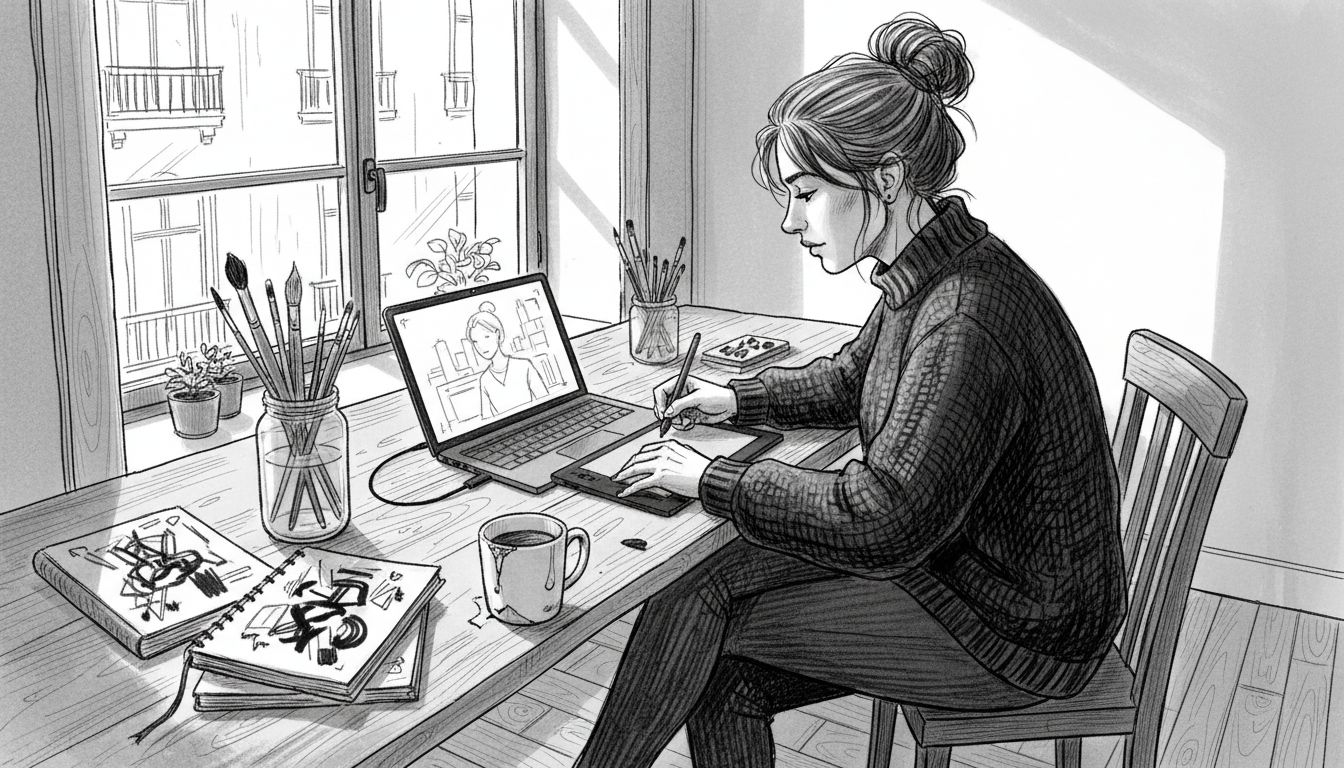
7 Essential Steps to Mastering AI Model Art Skills
Nearly 60 percent of American artists now explore digital and AI powered mediums, signaling a major shift in how creativity is unleashed. AI model art is changing not just design studios but everyday creative expression across the United States. From mastering neural networks to selecting the right frameworks, this guide reveals the essential steps for bringing your own artistic vision to life with powerful, cutting edge technology.
Table of Contents
- Understand The Basics Of AI Model Art
- Select The Best Tools And Frameworks
- Explore Dataset Curation And Preprocessing
- Implement Model Training For Art Generation
- Fine-Tune Models For Artistic Quality
- Evaluate And Iterate Your AI Art Projects
- Showcase And Share Your AI Model Art
1. Understand the Basics of AI Model Art
AI model art represents a groundbreaking intersection where machine learning meets creative expression, transforming how artists and technologists generate visual content. At its core, AI model art leverages advanced algorithms to create, modify, and synthesize images through sophisticated neural network techniques.
The foundation of AI model art lies in understanding Generative Adversarial Networks (GANs), which are powerful machine learning frameworks that enable computers to generate stunningly realistic artistic images. Generative models like GANs have revolutionized digital art creation by learning complex visual patterns and generating novel artistic content.
Understanding geometric data integration is crucial in developing high quality AI art models. Researchers have discovered innovative techniques for separating artistic style from content, which allows more nuanced and sophisticated image generation. This approach helps AI systems understand and recreate intricate visual characteristics with remarkable precision.
Practical implementation requires learning key skills:
Core Skills for AI Model Art:
- Understanding neural network architectures
- Mastering image processing techniques
- Learning style transfer algorithms
- Developing computational creativity skills
Beginners should start by exploring open source AI art tools and platforms that provide hands on experience with generative models. Experiment with different machine learning frameworks and practice creating unique visual representations through algorithmic processes.
The true magic of AI model art emerges when you combine technical understanding with creative intuition. By seeing AI not just as a tool but as a collaborative artistic partner, you can unlock unprecedented forms of visual expression.
2. Select the Best Tools and Frameworks
Selecting the right tools and frameworks is critical for anyone serious about mastering AI model art. Your technological infrastructure determines the quality, efficiency, and creative potential of your artistic outputs.
Modern AI art generation relies heavily on powerful machine learning frameworks that enable sophisticated image synthesis. Advanced AI development tools provide artists and technologists with unprecedented capabilities for creating complex visual content.
Key Considerations for Tool Selection:
- Computational performance
- Flexibility and customization options
- Community support and documentation
- Compatibility with various AI model architectures
Research suggests that Generative Adversarial Networks (GANs) represent a powerful approach for artistic image generation. When evaluating frameworks, prioritize those offering robust GAN implementations and support for geometric data integration.
Popular frameworks like TensorFlow, PyTorch, and Keras offer unique advantages for AI model art. TensorFlow provides excellent visualization tools, PyTorch enables dynamic computational graphs, and Keras offers user friendly high level APIs that simplify complex model development.
Practical selection requires understanding your specific artistic goals. Some frameworks excel at style transfer, while others specialize in high resolution image synthesis. Experiment with multiple tools to discover which best matches your creative vision and technical skills.
Beyond technical specifications, consider the learning curve and available community resources. Frameworks with strong documentation, active user forums, and comprehensive tutorials can dramatically accelerate your skill development in AI model art.
3. Explore Dataset Curation and Preprocessing
Dataset curation and preprocessing are critical foundations for developing powerful AI model art. The quality of your training data directly determines the sophistication and authenticity of your AI generated artistic outputs.
Geometric data extraction and preprocessing play a pivotal role in training AI models to understand and replicate complex artistic styles. By carefully selecting and preparing your datasets, you can significantly enhance the model’s ability to generate nuanced and compelling visual art.
Key Dataset Preprocessing Strategies:
- Normalize image dimensions
- Remove irrelevant or low quality images
- Balance representation across art styles
- Implement robust data augmentation techniques
Recent research reveals fascinating insights into the differences between human and AI generated art. Comparative studies demonstrate that meticulous dataset preparation helps AI models more accurately capture the subtle nuances of human artistic expression.
Practical dataset curation involves several critical steps. First, collect diverse images representing multiple artistic styles and techniques. Then carefully clean your dataset by removing duplicates, correcting color variations, and standardizing image formats.
Advanced preprocessing techniques include applying style transfer algorithms, extracting geometric features, and implementing machine learning techniques that help your AI model understand artistic composition. Pay special attention to maintaining the intrinsic characteristics of different art movements while creating a comprehensive training dataset.
Remember that successful AI art generation is not just about quantity but about the strategic selection and intelligent preprocessing of your training images. Take time to curate a dataset that truly represents the artistic diversity and complexity you want your AI model to learn.
4. Implement Model Training for Art Generation
Training AI models for art generation requires a sophisticated approach that combines technical precision with creative understanding. The goal is to develop a neural network capable of generating original artistic content that captures the essence of human creativity.
Advanced training methodologies for Generative Adversarial Networks (GANs) provide powerful techniques for developing AI art models. These frameworks enable complex learning processes that help neural networks understand and replicate artistic styles with remarkable accuracy.
Key Training Considerations:
- Select appropriate loss functions
- Implement progressive training techniques
- Balance generator and discriminator performance
- Monitor model convergence carefully
Computational frameworks combining neural latent spaces offer innovative approaches to understanding artistic representation. By analyzing aesthetic features and computational learning strategies, you can develop AI models that generate increasingly sophisticated artistic outputs.
Practical implementation involves several critical steps. Begin by configuring your neural network architecture to handle complex artistic representations. Use transfer learning techniques to leverage pre existing knowledge and accelerate model training.
Experiment with different hyperparameters and training strategies. Some models respond better to incremental complexity introduction, while others require comprehensive training across diverse artistic styles. Pay attention to how your model interprets and generates artistic content.
Remember that successful AI art generation is an iterative process. Your first attempts will likely produce imperfect results, but consistent refinement and strategic training can transform your AI model into a powerful artistic tool. Patience and systematic experimentation are your greatest assets in mastering AI model art generation.
5. Fine-Tune Models for Artistic Quality
Fine-tuning AI models for artistic quality transforms raw computational power into nuanced creative expression. The art of refinement separates mediocre AI generated images from truly compelling artistic outputs.
Advanced training methodologies for Generative Adversarial Networks (GANs) provide sophisticated techniques for enhancing model performance. These approaches allow AI systems to develop increasingly complex and aesthetically pleasing artistic representations.
Key Fine-Tuning Strategies:
- Implement style transfer techniques
- Adjust loss function parameters
- Incorporate aesthetic evaluation metrics
- Use progressive complexity training
Geometric data integration offers powerful methods for distinguishing between artistic style and content. By carefully analyzing and refining how your model interprets visual information, you can dramatically improve the quality of generated art.
Optimizing AI model performance requires a systematic approach. Start by identifying specific aesthetic weaknesses in your current model. Experiment with targeted adjustments to neural network architecture and training parameters.
Consider implementing transfer learning techniques that leverage pre existing artistic knowledge. This approach allows your model to build upon established visual understanding rather than generating art from scratch.
Successful fine-tuning is an iterative process. Continuously evaluate your model output against human created art. Look for subtle nuances in texture, composition, and emotional resonance. The goal is not just to replicate existing art but to create something that feels genuinely innovative and artistically compelling.
6. Evaluate and Iterate Your AI Art Projects
Evaluating and iterating AI art projects is crucial for transforming computational outputs into genuinely compelling artistic experiences. The process requires a systematic approach that balances technical precision with creative intuition.
Computational frameworks comparing human and AI paintings provide sophisticated methods for assessing artistic quality. These research driven techniques help artists and engineers understand the nuanced differences between machine generated and human created art.
Key Evaluation Strategies:
- Implement quantitative aesthetic metrics
- Conduct blind comparison studies
- Analyze stylistic consistency
- Track model performance across iterations
Measuring the success of diffusion models reveals critical insights into AI art generation. By systematically tracking how closely AI outputs mimic human artistic styles, you can develop increasingly sophisticated models.
Understanding potential AI project failure points allows for more strategic development. Start by creating a structured evaluation framework that includes both objective technical measurements and subjective artistic assessments.
Develop a comprehensive feedback loop. Show your AI generated art to diverse audiences including artists, designers, and general viewers. Collect qualitative feedback alongside quantitative performance metrics to gain holistic insights.
Remember that iteration is an ongoing process. Each evaluation cycle provides valuable information about your model’s strengths and limitations. Approach each iteration with curiosity and a commitment to continuous improvement.
7. Showcase and Share Your AI Model Art
Showcasing your AI model art transforms your technical achievements into creative expression that can inspire and challenge artistic perspectives. The world of digital art is rapidly evolving, creating unprecedented opportunities for AI artists to share their unique visual creations.
Strategic Sharing Approaches:
- Create online portfolios
- Participate in digital art communities
- Submit to AI art exhibitions
- Engage with professional networks
Platforms like Artbreeder demonstrate the power of collaborative machine learning art websites, allowing artists to generate and share images through innovative digital interfaces. These platforms provide accessible venues for displaying your AI generated artwork.
Building an AI portfolio requires strategic presentation of your projects, highlighting both technical complexity and creative innovation. Consider documenting your creative process, explaining the algorithms and techniques used in generating each piece.
Examples like Ai-Da, the humanoid robot artist, demonstrate how AI art can capture public imagination. By presenting your work thoughtfully and explaining the underlying computational techniques, you transform technical output into compelling artistic narrative.
Remember that sharing is about connecting with audiences. Accompany your artwork with context that explains the computational journey behind each image. Tell the story of how machine learning algorithms can create unexpected and beautiful visual experiences.
Do not be afraid to experiment with different platforms and communities. Each showcase is an opportunity to learn, receive feedback, and refine your approach to AI model art creation.
Below is a comprehensive table summarizing the key concepts and strategies discussed throughout the article about AI model art.
| Topic | Description | Key Considerations |
|---|---|---|
| AI Model Art Basics | Combination of machine learning and creative expression leveraging neural networks like GANs to create art. | Importance of understanding GANs, geometric data integration, and core skills such as neural networks and style transfer. |
| Tool Selection | Choosing frameworks and tools for image synthesis including TensorFlow, PyTorch, and Keras. | Consider computational performance, flexibility, community support, and GAN implementation support. |
| Dataset Curation | Preprocessing and selecting training data to enhance AI outputs. | Normalize dimensions, remove low-quality images, balance styles, and use data augmentation. |
| Model Training | Sophisticated approach to train AI models like GANs to generate artistic content. | Choose appropriate loss functions, balance performance, and use progressive training techniques. |
| Fine-Tuning Models | Refining models for quality by adjusting network parameters and incorporating evaluation metrics. | Implement style transfer, optimize for complexity, and improve model performance with feedback. |
| Evaluation & Iteration | Systematically assess AI art for quality using computational frameworks and feedback loops. | Use quantitative aesthetic metrics, conduct studies, and incorporate diverse audience feedback. |
| Showcasing Art | Sharing AI-generated art through online platforms and exhibitions. | Create portfolios, engage with communities, and explain the creative process with context and narrative. |
Accelerate Your Journey to Mastering AI Model Art Skills
The article “7 Essential Steps to Mastering AI Model Art Skills” highlights key challenges like mastering neural network architectures, selecting the right tools such as GANs, and fine-tuning models for exceptional artistic quality. If you feel overwhelmed by the technical complexities or struggle to translate theory into practical AI artistry, you are not alone. The path to creating unique AI-generated art requires not only understanding concepts like geometric data integration and style transfer algorithms but also consistent hands-on practice and expert guidance.
Ready to take your AI art skills to the next level? Join the AI Native Engineer community on Skool where you can connect with fellow AI artists, access advanced tutorials, and get hands-on guidance from experienced practitioners. The community offers exclusive resources on practical AI implementation, real-world project feedback, and collaborative learning opportunities that will accelerate your journey from beginner to expert. Don’t navigate the complex world of AI model art alone - become part of a vibrant network committed to turning AI theory into impactful artistic innovation. Sign up today and start creating breakthrough AI art with the support of a community that understands your challenges and celebrates your successes.
Frequently Asked Questions
What are the core skills needed to master AI model art?
To master AI model art, you need to understand neural network architectures, image processing techniques, style transfer algorithms, and computational creativity skills. Start by dedicating time to each area systematically, perhaps spending a few weeks on foundational concepts before moving to more advanced techniques.
How do I select the best tools for creating AI model art?
Select tools based on computational performance, flexibility, community support, and compatibility with AI models like Generative Adversarial Networks (GANs). Spend a week evaluating various frameworks and try each one on a small project to determine which aligns with your creative vision.
What steps should I follow for dataset curation and preprocessing?
Begin with collecting diverse images that represent multiple artistic styles, then normalize dimensions and remove low-quality images. Dedicate at least two to three weeks for careful curation and preprocessing to enhance your AI model’s training quality.
How can I effectively train my AI model for art generation?
Train your AI model by selecting appropriate loss functions, implementing progressive training techniques, and balancing the performance between the generator and discriminator. Consider running multiple training sessions over a month to fine-tune your model parameters for better output.
What strategies can I use to fine-tune my AI art models for quality?
Fine-tune your models by adjusting loss function parameters, incorporating aesthetic evaluation metrics, and using style transfer techniques. Aim to refine your model iteratively over several weeks, focusing on specific aesthetic attributes each session.
How can I evaluate and iterate on my AI art projects?
Evaluate your AI art projects by establishing a structured framework that includes both quantitative metrics and qualitative assessments from diverse audiences. Set up a feedback loop and plan for regular evaluations every few weeks to progressively refine your artistic outputs.
Recommended
- How to Train Models and Master Your AI Skills
- How to Train Models - Master Your AI Skills Effectively
- Master Testing AI Models A Step-by-Step Guide
- Improving Model Accuracy Step-by-Step Guide for AI Engineers
- Why Choose AI as a Career: Complete Guide - Ambeone