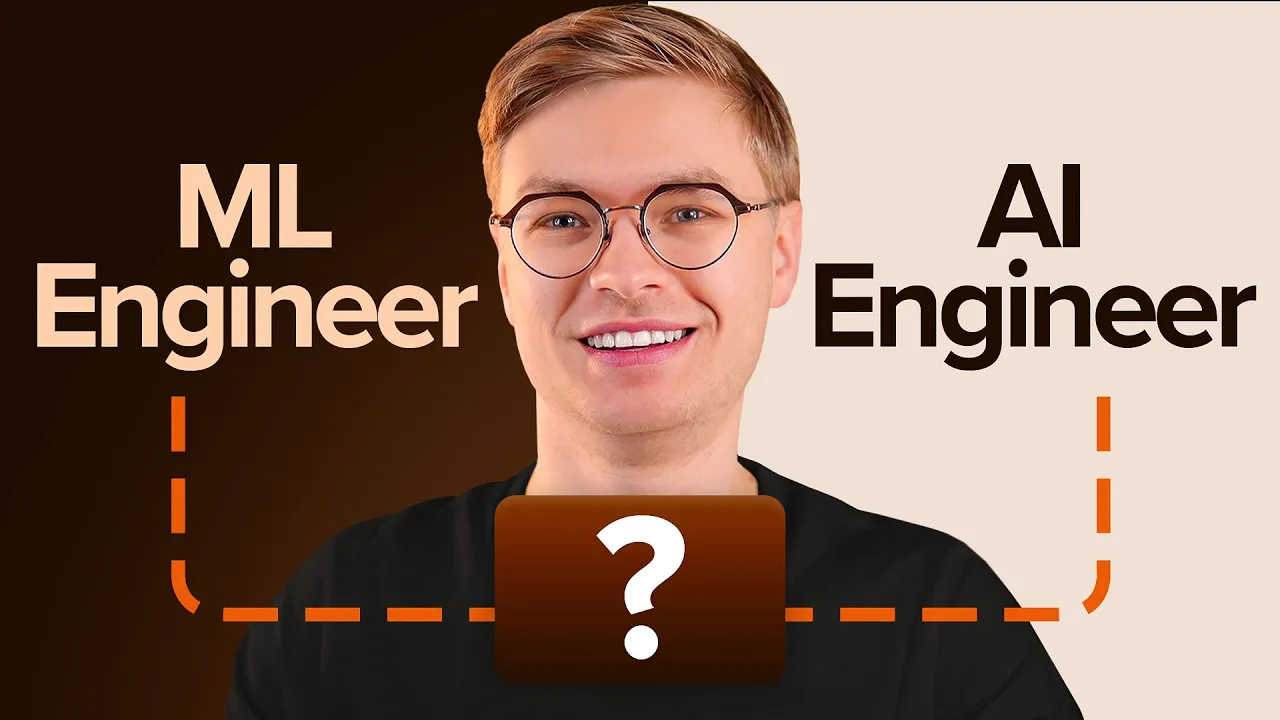
AI Engineer vs ML Engineer Which Career Path Fits Your Skills
While everyone debates which AI role pays more, the real question is which path matches how you actually want to work. The difference between AI engineers and ML engineers isn’t just about salary ranges or job titles. It’s about fundamentally different approaches to building with artificial intelligence.
What AI Engineers Actually Do
AI engineers integrate existing models into applications that solve real problems. You’re not training models from scratch or optimizing loss functions. You’re taking powerful pre-trained models and building products around them. Think of it as software engineering with an AI integration layer.
The work centers on shipping and iterating. You build a transcription app using Whisper, test it with real users, and refine based on feedback. You integrate GPT-4 into a customer service tool and optimize the prompts for better responses. The goal is always the same: deliver value quickly and improve continuously.
This approach aligns closely with traditional AI engineering skills that focus on integration and deployment rather than theoretical optimization.
What ML Engineers Actually Do
ML engineers train models from scratch. You need deep knowledge of mathematics, statistics, and data science. Your day involves feature engineering, hyperparameter tuning, and proving why your model performs better than the baseline.
The work is theoretical and research-oriented. You’re not just using existing models; you’re creating new ones or significantly improving current architectures. This requires understanding the math behind gradient descent, knowing when to use different optimization algorithms, and being able to debug why your model isn’t converging.
The competition is brutal. You’re up against PhDs in statistics and computer science who’ve spent years studying the theoretical foundations. Breaking into ML engineering without that academic background is possible but significantly harder.
The Accessibility Factor
AI engineering is dramatically more accessible for self-taught developers. If you already know software development, you’re halfway there. The additional skills involve learning how to work with APIs, understanding prompt engineering, and knowing which models solve which problems.
You don’t need a PhD. You don’t need years of statistics coursework. You need to understand software architecture and be willing to learn how AI models behave in production environments.
ML engineering has a much steeper learning curve. Without a strong foundation in linear algebra, calculus, and probability theory, you’ll struggle to understand why your models fail. The entry barrier isn’t artificial; it reflects the genuine complexity of the work.
For those considering the AI developer career path, understanding these accessibility differences is crucial for setting realistic expectations.
The Future-Proofing Argument
Even as AI models become more powerful, someone needs to integrate them into actual products. You can’t just drop GPT-5 into your codebase and expect magic. You need engineers who understand both software architecture and AI capabilities.
AI engineers bridge the gap between powerful models and practical applications. That role becomes more valuable as models improve, not less. Better models mean more integration opportunities, more edge cases to handle, and more complex systems to build.
ML engineering faces different pressures. As foundation models improve, the need for custom model training decreases for many use cases. The role won’t disappear, but it may concentrate in research labs and companies with truly unique data or requirements.
Making Your Decision
Choose AI engineering if you want to build and ship products quickly. If you enjoy software development and want to add AI capabilities to your toolkit, this path offers immediate opportunities. The growing demand for AI engineers reflects how many companies need these integration skills right now.
Choose ML engineering if you love the theoretical side and have the mathematical foundation. If optimizing model performance excites you more than shipping features, and you’re willing to compete with PhD candidates, this path offers deep technical challenges.
Both roles are valuable. Both have strong job markets. The right choice depends on your existing skills, learning preferences, and career goals. Don’t choose based on perceived prestige or salary potential. Choose based on the type of work you want to do every day.
Watch the full breakdown and see a live demo of AI engineering in action: AI Engineer vs ML Engineer on YouTube
Want to connect with other AI engineers navigating these career decisions? Join our community where we discuss practical AI implementation and career growth strategies.