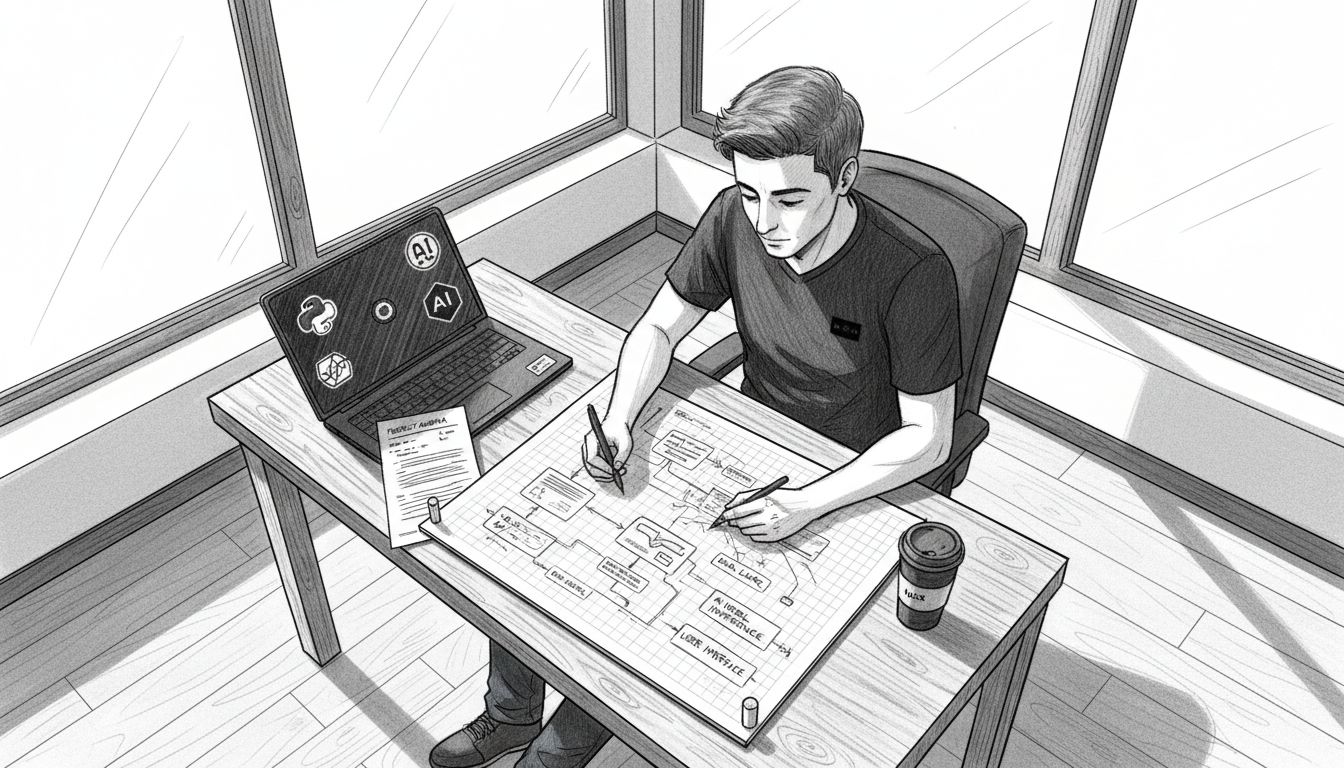
Building Neural Networks Step-by-Step for AI Engineers
Over 60 percent of AI projects fail to meet their intended goals. The difference between success and failure usually comes down to how well you planned before writing any code. This guide walks through the full process, from setting requirements to deployment, so you can build neural networks that actually work.
Table of Contents
- Step 1: Define Project Requirements And Goals
- Step 2: Set Up Your Development Environment
- Step 3: Design Neural Network Architecture
- Step 4: Implement And Train Your Neural Network Model
- Step 5: Evaluate And Optimize Model Performance
- Step 6: Deploy And Monitor Your Neural Network
Step 1: Define project requirements and goals
Before you write any code, get clear on what you’re actually building and why.
Run a requirements specification analysis that maps out exactly what your neural network needs to do. Break requirements into specific categories: performance metrics, computational constraints, training data needs, expected accuracy. Answer the basics first: What problem are you solving? What outputs do you need? What hardware limitations exist?
Be specific. If you’re building a predictive model, don’t just say “predict accurately.” Say “predict project timelines with less than 5% error.” AI prediction frameworks can help you think through these specifications.
Pro Tip: Document requirements with your stakeholders, not in isolation. Misaligned expectations kill projects.
Step 2: Set up your development environment
Get your tools in order before diving into model building.
Check out IDE setup guides for ML projects to get started. Install Python, TensorFlow or PyTorch, and an IDE like VS Code or PyCharm. Pay attention to version compatibility between your libraries. Nothing wastes time like debugging dependency conflicts.
Create a dedicated project directory with a virtual environment. This keeps dependencies isolated and makes your work reproducible. Use pip or Anaconda to manage packages.
Pro Tip: Use Git from day one. You’ll thank yourself later when you need to roll back changes or collaborate with others.
Step 3: Design neural network architecture
Now you’re picking the structure that will actually learn from your data.
Visual neural network design tools can help you plan this out. Match your architecture to your problem: CNNs for images, RNNs for sequential data, transformers for complex patterns. Each layer should have a clear purpose.
Map out your network topology: layer types, neuron counts, activation functions. Think about depth, overfitting risk, and compute requirements. More layers isn’t always better.
Pro Tip: Start simple. Get a basic model working first, then add complexity. It’s much easier to debug a simple model than a 50-layer beast.
Step 4: Implement and train your neural network model
This is where your design actually starts learning.
Prepare your training data: clean it, format it properly, make sure it represents the real problem you’re solving. Split into training, validation, and test sets. When training models, pick loss functions, optimizers, and learning rates that match your architecture and problem.
Watch the training process closely. Track loss and accuracy. Use early stopping to prevent overfitting. Try techniques like learning rate scheduling, dropout, and batch normalization to help your model generalize better.
Pro Tip: Save checkpoints during training. When something goes wrong (and it will), you’ll want to roll back to a known good state.
Step 5: Evaluate and optimize model performance
Your model is trained. Now find out if it’s actually good.
Use proper evaluation techniques that avoid data leakage. Calculate accuracy, precision, recall, and F1 score across your dataset. Understanding evaluation metrics helps you spot weaknesses and know where to focus optimization.
Try hyperparameter tuning with grid search, random search, or Bayesian optimization. Look at cross-validation scores and performance on data the model hasn’t seen. Consider ensemble methods, better features, or more regularization if you’re not hitting your targets.
Pro Tip: Keep a holdout test set completely untouched during optimization. That’s your final reality check.
Step 6: Deploy and monitor your neural network
A model sitting on your laptop doesn’t help anyone. Time to get it into production.
Look into deployment architectures for AI systems and learn the deployment process. Pick a strategy: Docker containers, cloud platforms, or edge devices. Make sure your deployment environment can handle the compute requirements you established earlier.
Set up monitoring from day one. Track key metrics, detect drift, and alert on problems. Use automated logging and set baselines so you know when performance degrades. Consider A/B testing or shadow deployments to reduce risk during rollout.
Pro Tip: Build dashboards that show you model performance in real time. You want to catch problems before your users do.
Take Your Neural Network Skills Further
Building neural networks is challenging. Requirements, architecture, training, deployment. Each step has its own pitfalls. But once you’ve built a few models end-to-end, the process becomes intuitive.
Want hands-on guidance building production neural networks? Join the AI Engineering community where I share tutorials, code examples, and work directly with engineers building real systems.
Inside, you’ll find practical strategies that work, plus direct access to ask questions and get feedback on your implementations.
Frequently Asked Questions
What are the key steps to building a neural network?
To build a neural network, follow these key steps: define project requirements and goals, set up your development environment, design the neural network architecture, implement and train the model, evaluate and optimize performance, and finally deploy and monitor the network. Start by documenting clear requirements to guide your project.
How do I determine the requirements for my neural network project?
Determine your project’s requirements by conducting a comprehensive analysis that maps out the specific problem you are solving, expected outputs, performance metrics, and computational constraints. Break down these requirements into measurable categories for clarity.
What should I include in my neural network architecture design?
In your neural network architecture design, include specific layer types, neuron counts, activation functions, and ensure smooth connections between layers. Consider starting with a simpler model to avoid complexity and progressively enhance it based on performance outcomes.
How can I optimize my model’s performance after training?
Optimize your model’s performance by utilizing hyperparameter tuning techniques like grid search or random search. Focus on improving metrics like accuracy and generalization capabilities while ensuring to keep a separate test set for unbiased evaluation.
What strategies can I use for deploying my neural network?
For deploying your neural network, explore methods like containerization, cloud integration, or edge device implementation based on your project’s needs. Ensure that your deployment environment aligns with the computational requirements defined during development to maintain optimal performance.
How do I monitor my neural network after deployment?
Monitor your neural network by setting up automated logging systems and performance alerts. Regularly track key performance indicators to detect any potential drift and respond quickly to changes in behavior, ensuring your model remains effective over time.
Recommended
- 7 Essential Steps to Mastering AI Model Art Skills
- 7 Essential Applications of AI in Real Life for Engineers
- Why AI Engineering Is the Most Accessible Path Into AI Careers
- Natural Language Processing - Transforming AI Interaction
- 7 Key Advantages of AI in Sales for B2B Success