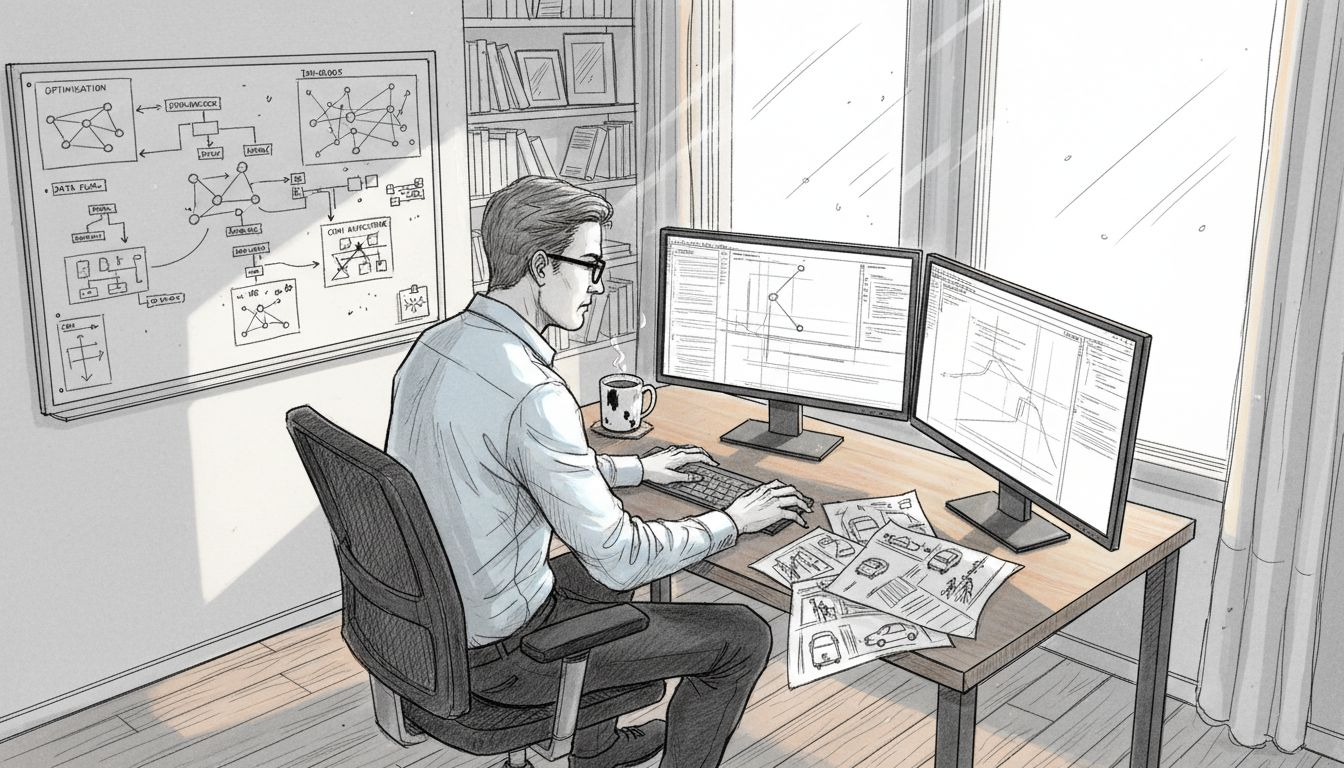
Computer Vision Challenges - Practical Solutions for AI Engineers
Computer Vision Challenges: Practical Solutions for AI Engineers
Most american computer vision projects face at least one major algorithmic or data-related obstacle before deployment. Despite rapid technological progress, engineers worldwide still struggle with unpredictable lighting, confusing visual environments, and models that fail in real-world settings. This overview unpacks why misconceptions around robustness persist and reveals practical strategies to tackle persistent roadblocks in computer vision, guiding you toward more reliable solutions and technical confidence.
Table of Contents
- Defining Computer Vision Challenges And Misconceptions
- Categories Of Computer Vision Problems In Practice
- Key Features And Real-World Use Cases
- Data Limitations And Model Robustness Risks
- Troubleshooting Common Issues And Mitigation Strategies
Defining Computer Vision Challenges and Misconceptions
Computer vision represents a complex technological frontier where artificial intelligence attempts to interpret and understand visual information, much like the human visual system. Despite significant technological advancements, persistent challenges continue to challenge AI engineers globally, requiring sophisticated problem solving and nuanced understanding of algorithmic limitations.
The primary misconception surrounding computer vision is the assumption of universal algorithmic robustness. In reality, computer vision systems struggle with numerous real-world constraints, including variable lighting conditions, partial object occlusion, and significant environmental variations. These challenges mean that while AI can process visual data impressively, achieving human-level perception remains extraordinarily complex. Research indicates that current computer vision models have substantial interpretability and generalization limitations, which significantly impact their practical deployment across different domains.
Key challenges in computer vision include:
- Handling complex visual scenarios with multiple objects
- Managing dramatic shifts in perspective and lighting
- Developing algorithms capable of understanding contextual nuance
- Creating systems that can generalize learning across different visual environments
Pro tip: When developing computer vision models, always test extensively across diverse environmental conditions to understand true algorithmic performance and potential failure points.
Categories of Computer Vision Problems in Practice
Computer vision problems can be systematically categorized into distinct domains that represent specific computational challenges for AI engineers. Academic research reveals multiple core problem categories ranging from fundamental image processing to advanced interpretive tasks, each requiring specialized algorithmic approaches and unique technical strategies.
The primary categories of computer vision problems include object detection, image classification, image segmentation, and semantic understanding. These categories represent increasingly complex computational challenges that demand sophisticated machine learning techniques. Practical applications across industries demonstrate that computer vision challenges extend beyond mere technical complexity to include significant data quality and hardware limitations, making problem categorization crucial for effective solution design.
Key problem categories in more granular detail include:
Here’s a quick reference table outlining major computer vision problem categories and their typical business applications:
| Problem Category | Primary Function | Business Impact |
|---|---|---|
| Object Detection | Locate key items in images | Enables automated inspection, safety |
| Semantic Segmentation | Divide visual scenes by meaning | Improves medical diagnosis, precision farming |
| Tracking | Follow item movement over time | Enhances traffic monitoring, retail analytics |
| Pose Estimation | Measure object orientation | Advances robotics, ergonomic studies |
- Object Detection: Identifying and localizing specific objects within images
- Image Classification: Assigning predefined category labels to entire images
- Semantic Segmentation: Precisely dividing images into meaningful pixel-level regions
- Instance Segmentation: Distinguishing between individual object instances within a scene
- Pose Estimation: Determining spatial orientation and positioning of objects
- Tracking: Following object movement across multiple image frames
Pro tip: When approaching computer vision problems, systematically analyze which specific problem category you are addressing to select the most appropriate algorithmic and architectural strategy.
Key Features and Real-World Use Cases
Computer vision technologies have evolved dramatically, transforming how machines interpret visual information across multiple industries. Cutting-edge research highlights the diverse features that enable sophisticated visual recognition and analysis systems, demonstrating remarkable technological capabilities that extend far beyond simple image processing.
The key technological features driving computer vision applications include advanced object detection, precise image classification, semantic understanding, and multi-modal data integration. These technological innovations are enabling groundbreaking solutions in critical sectors like healthcare, autonomous transportation, and smart city infrastructure, addressing complex real-world challenges with unprecedented accuracy and efficiency.
Significant real-world use cases span multiple domains:
- Healthcare: Diagnostic image analysis, medical scan interpretation
- Autonomous Vehicles: Real-time object detection, lane tracking, pedestrian identification
- Manufacturing: Quality control, defect detection, robotic guidance systems
- Retail: Customer behavior analysis, automated checkout, inventory management
- Security: Facial recognition, surveillance monitoring, threat detection
- Agriculture: Crop health monitoring, pest detection, precision farming
Pro tip: When exploring computer vision applications, focus on understanding the specific problem domain and selecting appropriate feature extraction techniques that align with your precise technological requirements.
Data Limitations and Model Robustness Risks
Computer vision models face significant challenges in maintaining reliability and performance across diverse real-world environments. Rigorous benchmarking research reveals critical vulnerabilities in deep learning image classification models when exposed to adversarial attacks and natural data variations, highlighting the complex trade-offs between model flexibility and stability.
The primary data limitations threatening model robustness emerge from multiple interconnected factors. Comprehensive surveys demonstrate that computer vision systems are particularly susceptible to common data corruptions including noise, blur, illumination changes, and environmental perturbations, which can dramatically undermine model performance and generalization capabilities across different operational contexts.
Key robustness risks include:
The following table compares common computer vision robustness risks and standard mitigation strategies:
| Robustness Risk | Typical Impact | Mitigation Strategy |
|---|---|---|
| Data Noise | Accuracy reduction | Advanced filtering, cleaning |
| Illumination Variation | Inconsistent detection | Augmented training data |
| Adversarial Attacks | Model misclassification | Defensive deep learning techniques |
| Contextual Errors | Wrong interpretation | Incorporate meta-data, ensemble models |
- Data Quality Variations: Inconsistent training data representativeness
- Environmental Sensitivity: Performance degradation under changing conditions
- Adversarial Vulnerability: Susceptibility to intentional input manipulations
- Generalization Constraints: Limited ability to adapt to unseen scenarios
- Computational Bias: Inherited biases from training dataset composition
- Contextual Misinterpretation: Challenges in understanding nuanced visual contexts
Pro tip: Implement comprehensive data augmentation strategies and regularly validate model performance across diverse, challenging input scenarios to systematically improve robustness and reliability.
Troubleshooting Common Issues and Mitigation Strategies
Computer vision engineers routinely encounter complex challenges that demand sophisticated diagnostic and resolution approaches. Advanced techniques now offer comprehensive strategies for addressing traditional obstacles in object detection and image processing, transforming previously intractable issues into manageable technical problems.
The core troubleshooting methodology involves systematic identification and strategic intervention across multiple computational domains. Emerging deep learning techniques have significantly enhanced our ability to mitigate real-world variability and performance inconsistencies, enabling more robust and adaptable computer vision systems that can operate effectively across diverse environmental conditions.
Key troubleshooting strategies include:
- Preprocessing Optimization: Advanced data normalization techniques
- Augmentation Techniques: Synthetic data generation for improved model resilience
- Sensor Fusion: Integrating multiple data sources to enhance contextual understanding
- Transfer Learning: Leveraging pre-trained models to improve generalization
- Regularization Methods: Preventing overfitting through advanced algorithmic approaches
- Performance Monitoring: Continuous validation and model drift detection
Pro tip: Develop a systematic validation framework that tests your computer vision models under progressively challenging environmental conditions to systematically identify and address potential performance limitations.
Mastering Computer Vision Challenges With Expert Guidance
Computer vision engineers face complex challenges such as handling environmental variations, improving model robustness, and overcoming adversarial vulnerabilities. This article highlights the critical pain points like data limitations and algorithmic sensitivity that often stall practical AI solutions. If you recognize the struggle of balancing theoretical knowledge with real-world application, you are not alone. Grasping concepts like semantic segmentation, pose estimation, and robust model design is essential to unlock reliable AI performance.
At AI Native Engineer, you gain exclusive access to hands-on learning resources and expert insights that bridge the gap between complex AI theories and effective implementation. Explore advanced topics tailored for AI engineers including MLOps and AI system design strategies that directly address the challenges outlined here. Join a community of professionals committed to overcoming these obstacles and accelerating their careers now by visiting AI Native Engineer.
Ready to transform your understanding of computer vision? Begin your journey to mastering AI engineering today with practical tutorials and peer support at AI Native Engineer. Take action now and turn your expertise into solutions that work in the real world.
Want to accelerate your AI engineering skills and connect with like-minded professionals? Join the AI Native Engineer community on Skool where you will get access to exclusive tutorials, live Q&A sessions, and direct mentorship opportunities. Join the AI Native Engineer Skool community now and take your computer vision expertise to the next level!
Frequently Asked Questions
What are the main challenges in computer vision?
The main challenges in computer vision include handling complex visual scenarios with multiple objects, managing variations in perspective and lighting, understanding contextual nuances, and developing algorithms that generalize learning across different visual environments.
How can data limitations affect computer vision models?
Data limitations can lead to model robustness issues, including inaccuracies due to data noise, illumination changes, and adversarial attacks. These factors can significantly undermine the performance and generalization capabilities of computer vision systems.
What strategies can AI engineers use to improve model robustness?
AI engineers can improve model robustness by implementing data augmentation, utilizing advanced filtering and cleaning techniques, integrating multiple data sources via sensor fusion, and employing regularization methods to prevent overfitting.
What are common troubleshooting strategies for computer vision issues?
Common troubleshooting strategies include optimizing preprocessing techniques, using augmentation for synthetic data generation, applying transfer learning to enhance generalization, and establishing performance monitoring to detect model drift.
Recommended
- 7 Essential Applications of Computer Vision for AI Engineers
- 7 Essential Applications of Computer Vision for AI Engineers
- Key Challenges in AI Implementation for Engineers
- 7 Essential Applications of AI in Real Life for Engineers
- What Is The Role of Engineers in Prototyping - Driving Innovation