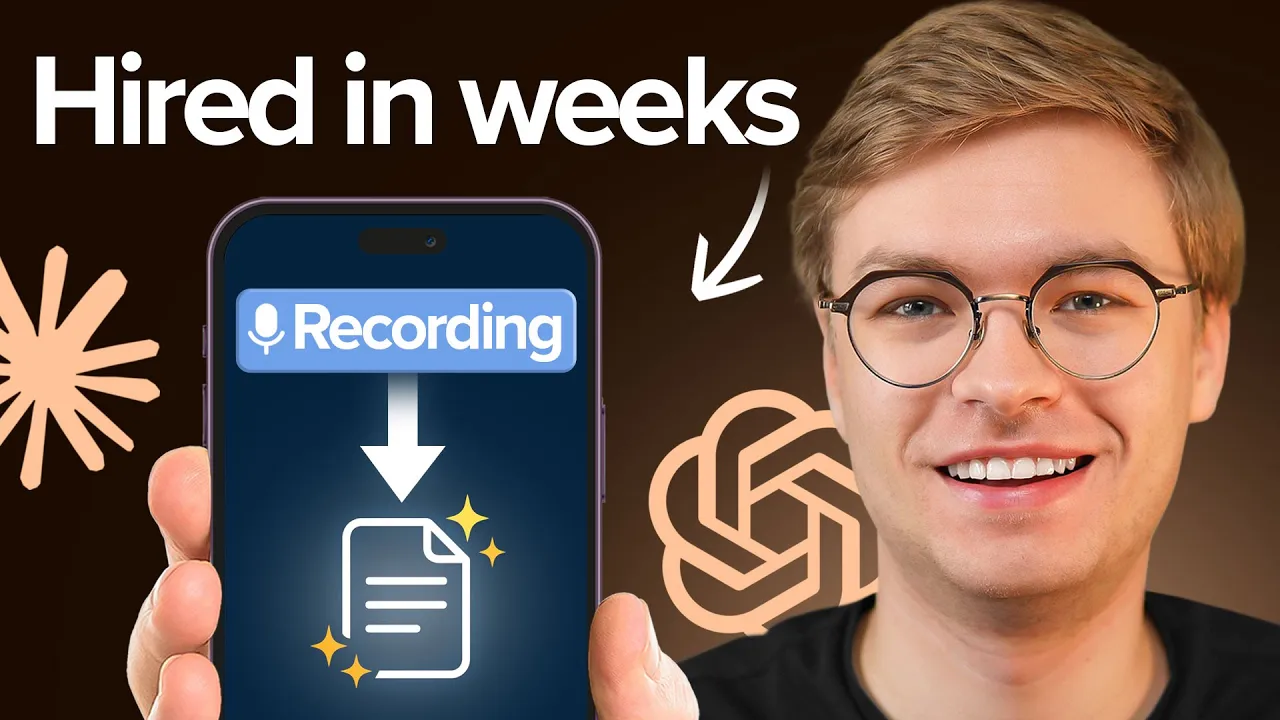
What Full Stack AI Engineering Actually Looks Like in Your Portfolio
The notion that AI portfolio projects need cutting-edge research to impress companies is killing your interview chances.
A working transcription tool that records voice, processes it with Whisper, and cleans up filler words with a local LLM demonstrates more full-stack capability than another BERT fine-tuning notebook.
Here’s what hiring managers actually look for when they review your portfolio.
The Full Stack AI Signal
When you build something like a local transcription tool, you’re proving competence across every layer companies care about:
Frontend thinking with browser APIs for audio capture. Backend architecture with FastAPI handling async requests. Model deployment running Whisper locally instead of burning API credits. LLM integration for post-processing transcriptions.
Each layer presents real engineering decisions. Which audio format minimizes latency? How do you structure endpoints for streaming responses? When does local inference beat cloud APIs? Which LLM provider gives you the best quality-to-cost ratio?
These questions don’t have academic answers. They have production answers based on measurement and tradeoffs.
That’s what companies hiring AI engineers in 2025 actually want to see: engineers who can navigate the full stack and ship working products.
Why Local Models Matter for Interviews
Running Whisper locally isn’t just about cost savings. It’s a signal that you understand the entire deployment landscape.
You know how to set up model inference outside of notebooks. You understand the memory-speed tradeoffs of different model sizes. You can explain when local processing makes sense versus when you should use hosted APIs.
In interviews, this becomes your advantage. While other candidates talk about training models, you talk about deploying them. While they discuss accuracy metrics, you discuss latency budgets and cost per request.
The technical conversation shifts from theory to production reality. That’s where AI engineering portfolio projects separate students from engineers.
Multiple LLM Providers Show Production Thinking
The choice to support multiple LLM providers in a portfolio project reveals something crucial: you’ve thought beyond the demo.
Production systems can’t depend on a single vendor. OpenAI has outages. Anthropic changes pricing. New models emerge with better performance characteristics. Engineers who understand this build abstraction layers from day one.
Your transcription tool switching between providers demonstrates this thinking without requiring enterprise-scale infrastructure. It shows you can design interfaces that hide implementation details. It proves you think about vendor lock-in and migration paths.
These architectural decisions matter more than model performance when companies evaluate whether you can build production AI systems.
The Interface Quality Signal
A clean, working interface separates engineers from researchers. It proves you care about the user experience, not just the technical implementation.
When your transcription tool loads quickly, shows clear status updates, and handles errors gracefully, you’re demonstrating product thinking. You’ve considered what happens when audio capture fails. You’ve thought about how to show progress during processing. You’ve tested the unhappy paths.
This attention to user-facing details shows up in portfolio projects that land six-figure offers. The technical depth exists, but it’s wrapped in an experience that non-technical interviewers can evaluate.
Production Decisions Over Algorithm Choices
The engineering skill shows up in your production decisions, not your algorithm choices. Using Whisper is straightforward. Deciding when to use Whisper versus cloud transcription APIs requires engineering judgment.
How do you make that decision? You measure latency. You calculate cost per hour of audio. You test accuracy on your domain’s audio quality. You consider privacy requirements and data residency constraints.
These measurements and tradeoffs form the narrative of your portfolio project. In interviews, you’re not explaining how Whisper works internally. You’re explaining why you chose it, what you measured, and what alternatives you considered.
That’s the conversation companies actually want during AI engineer interviews. They’re testing whether you can take requirements and turn them into defendable technical decisions.
Making It Industry-Specific
The generic transcription tool becomes interview-winning when you customize it for your target industry. Healthcare companies need HIPAA compliance. Legal firms need speaker diarization and timestamps. Media companies need export formats for editing tools.
Pick one vertical and add the features that matter to them. Now your portfolio project directly addresses the problems your target companies face daily.
You’re no longer showing general AI capability. You’re demonstrating domain-specific product thinking that maps directly to their business needs.
Your Next Steps
Build your full-stack AI project by starting with something you’ll actually use. The technical depth emerges from making real tradeoffs, not from adding complexity.
Make it faster by testing GPU acceleration versus cloud APIs. Add streaming for better user experience. Build in error handling for production reliability.
Focus on demonstrating capability across the stack: frontend, backend, model deployment, and LLM integration. That’s what converts portfolio views into interview offers.
See the Complete Technical Implementation
I built this entire transcription system and documented every engineering decision in the video below. You’ll see the FastAPI structure, local Whisper deployment, LLM integration, and the production considerations that separate portfolio projects from tutorials.
Full code repository and AI systems course included.
Watch the full technical walkthrough on YouTube
Join our AI engineering community to get feedback on your portfolio projects from engineers shipping production AI systems.