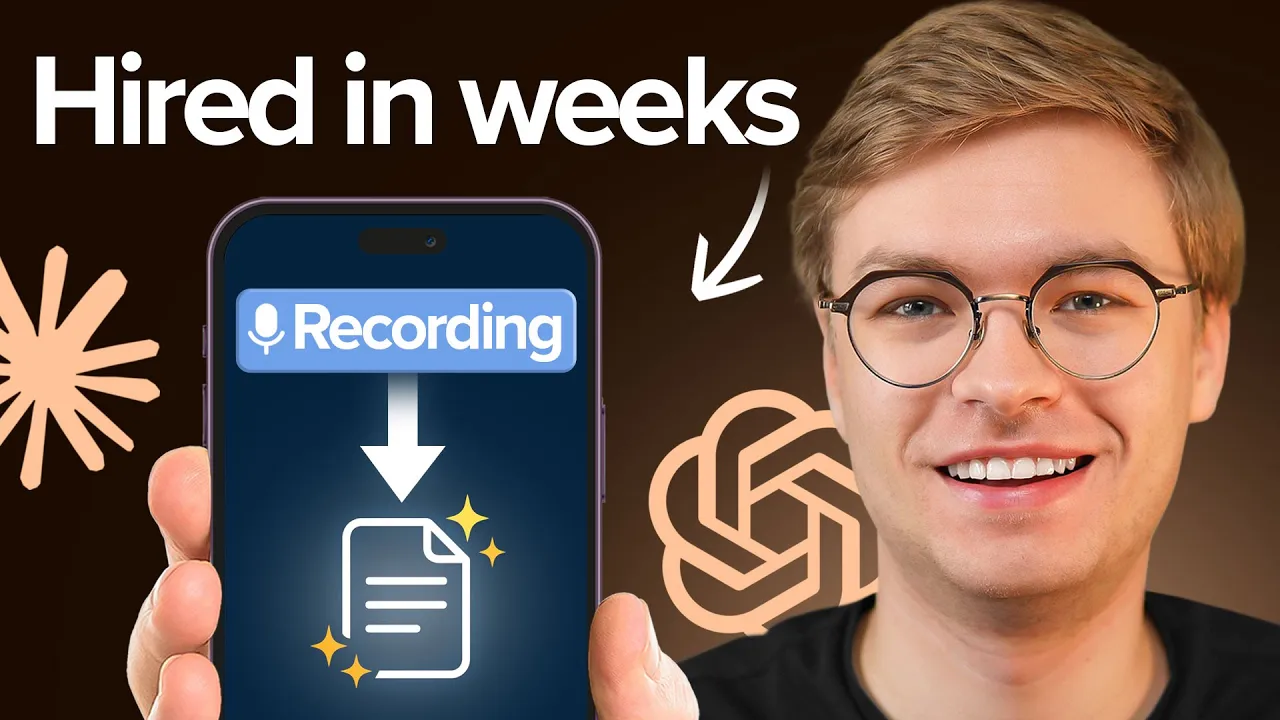
The Simple AI Project That Actually Lands Engineer Jobs
While everyone obsesses over implementing transformer architectures from scratch, a student named Vittor got hired by building something almost embarrassingly simple: a chatbot that answers questions about his consulting website.
No GPU clusters. No novel architectures. Just a working tool that solved a real problem.
The hiring manager told him straight up: “This is exactly what we need. Someone who can ship.”
Why Companies Skip the Complex Portfolios
The market shifted faster than most people realized. Companies don’t want researchers who can theorize about attention mechanisms. They want AI native engineers who ship products that users can actually touch.
Think about what happens in an interview when you show complex projects. The interviewer squints at your notebook, tries to understand your custom loss function, and mentally calculates how long it would take you to deliver something production-ready.
Now imagine showing them a tool they can use in 30 seconds. They type a question, get an answer, and immediately understand what you built. The complexity lives in production decisions, not algorithmic gymnastics.
What Actually Demonstrates Engineer Thinking
A simple transcription tool that runs locally demonstrates more engineering judgment than most academic projects. Here’s what it shows:
You understand browser APIs enough to capture audio. You know how to structure a FastAPI backend. You can run Whisper locally instead of burning API credits. You integrated an LLM to clean up filler words from transcriptions.
Each piece is simple. Together, they prove you can build full-stack AI applications.
The real signal comes from production decisions. Why run models locally? Because latency matters and API costs add up. Why multiple LLM providers? Because vendor lock-in kills startups. Why clean up the interface? Because engineers ship products people want to use.
This thinking separates portfolio projects that get interviews from tutorial code that gets ignored.
The Tutorial Project Trap
You can spot tutorial projects instantly. They optimize for learning, not shipping. They use toy datasets because the tutorial author needed something quick. They skip error handling because the focus was on the happy path.
Portfolio projects optimize for the opposite outcome. They solve real problems you actually have. They handle edge cases because users will find them. They make deployment decisions because someone needs to run this thing.
When you build a transcription tool because you’re tired of manually cleaning up interview recordings, you make different choices. You care about speed. You test with your actual messy audio files. You add features that matter to you.
That authenticity shows up in interviews. You can explain every decision because you lived with the consequences.
Making It Interview-Ready
The difference between a working project and an interview-winning project comes down to one question: can you explain why?
Why did you choose FastAPI over Flask? Because async support matters for audio processing. Why local models instead of cloud APIs? Because you tested both and measured the cost-latency tradeoff. Why this specific approach to cleaning transcriptions? Because you tried three methods and this one worked best for your use case.
These answers prove engineering judgment. They show you can evaluate options, make tradeoffs, and ship solutions.
The questions companies actually ask in AI engineer interviews test this thinking. They want to know if you can take a product requirement and turn it into working code that users depend on.
Your Portfolio Project Challenge
Build something you’ll actually use. Not something impressive, not something novel. Something that solves a problem you have right now.
Make it fast. Add GPU acceleration if you need speed. Switch to cloud LLMs if local models are too slow. Stream results instead of making users wait.
Customize it for your target industry. Healthcare companies want HIPAA compliance thinking. Finance companies want audit trails. Enterprise companies want SSO integration.
The technical depth emerges from making it production-ready, not from adding complexity for its own sake.
Watch the Full Technical Walkthrough
I built a complete transcription tool and walked through every engineering decision in the video below. You’ll see the FastAPI structure, the Whisper integration, the LLM cleanup process, and the production considerations that matter.
The full repo is free, plus a complete course on taking AI systems from proof-of-concept to production.
Watch the technical breakdown on YouTube
Want to discuss your portfolio project ideas with engineers who are actually shipping? Join our AI engineering community where we review projects and share what’s working in interviews.