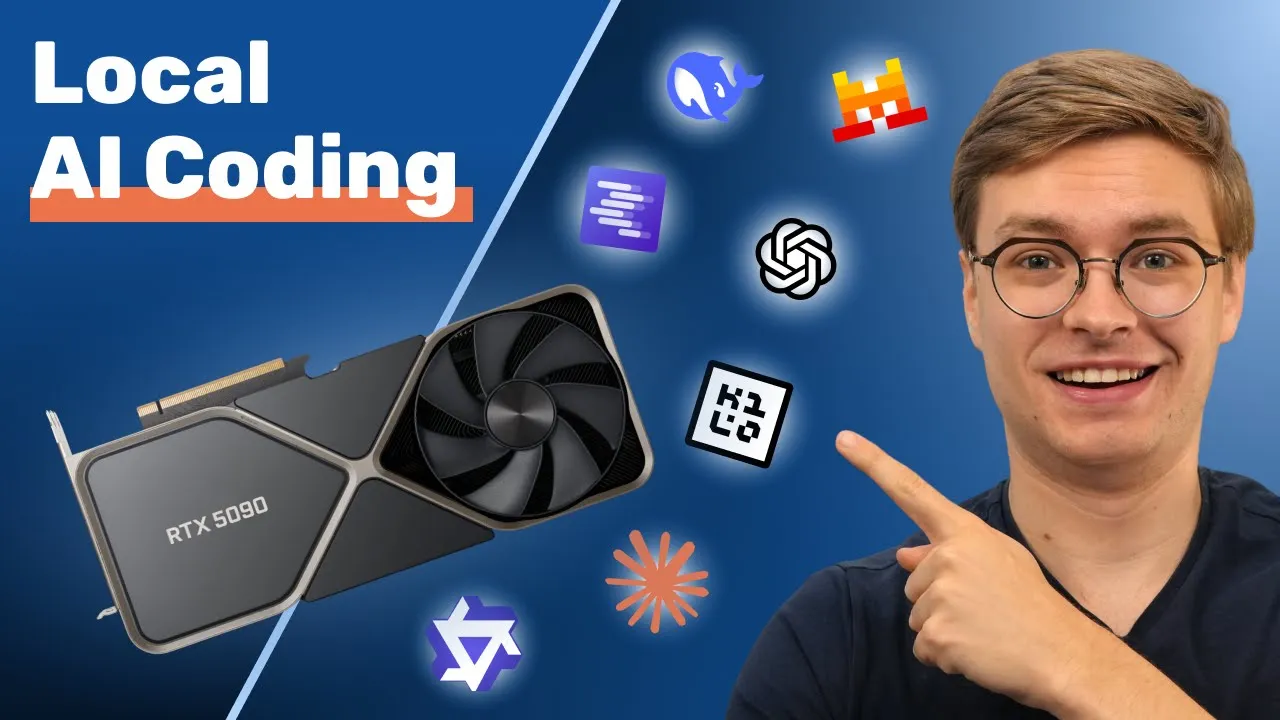
Understanding VRAM Requirements for Local AI Coding
While everyone talks about running AI models locally, few explain the fundamental constraint that determines what’s actually possible: VRAM. Your GPU’s memory capacity dictates which models you can run, how much context they can handle, and whether the experience is usable or frustratingly slow.
Running a local AI coding environment that actually works requires understanding these hardware realities. The tutorials that gloss over them leave you with setups that choke on real codebases.
Why VRAM Is the Real Limitation
To run local AI models, you need to load the entire model into your GPU’s dedicated memory. Not your system RAM, your VRAM. A 21GB model requires roughly 21GB of VRAM before you even start using it.
But that’s just the baseline. Every token of context you add consumes additional memory. A model that fits comfortably at 4,000 tokens of context might exceed your VRAM at 50,000 tokens. Real AI coding requires substantial context to work with your actual codebase, not the toy examples most demos show.
This is why so many developers try local AI coding, find it impossibly slow, and assume their hardware isn’t good enough. Often the issue isn’t hardware capability but configuration: they’re trying to load too much context for their available VRAM.
The Hardware Options That Actually Work
The most expensive consumer GPUs top out around 24-32GB of VRAM. That’s enough for serious local AI work, but it’s not accessible for everyone.
Here’s what most tutorials miss: MacBooks with Apple Silicon are surprisingly competitive for local AI. The M4 Pro with 48GB of unified memory gives you roughly 48GB available for AI models. That shared memory architecture means the RAM you’re already using for normal computing can also support AI inference.
This makes MacBooks a genuine budget option for local AI coding, which contradicts most assumptions about Apple hardware pricing. The cost per GB of usable VRAM is actually competitive with dedicated GPUs when you factor in the unified memory architecture.
For those on tighter budgets, older data center GPUs with high VRAM can work, though they may lack the speed of newer consumer cards. The tradeoff between memory capacity and inference speed varies by use case.
Understanding these options matters when you’re trying to run advanced models locally without breaking your budget.
Model Selection Strategy
Quantized models are essential for local AI coding. A 32B parameter model might be 64GB in full precision but only 21GB quantized. You sacrifice some accuracy for dramatic memory savings. For coding tasks, this tradeoff is usually worth it.
But bigger isn’t always better. A 20B parameter model with adequate context window beats a 32B model that can only handle 6,000 tokens. The context limitation kills the utility for real codebases faster than reduced reasoning capability.
Tools like LM Studio make this experimentation accessible. Download multiple models, test them with your actual projects, and find the configuration that balances capability with your hardware constraints.
The practical approach: start with smaller models and larger context windows. If the reasoning quality isn’t sufficient, step up to larger models and reduce context. Find the balance point where the model is smart enough and can see enough of your codebase.
Context Length Is Where It Gets Real
Most AI coding tutorials use minimal codebases as examples. A few hundred lines of code, maybe a thousand tokens of context. Real projects are different.
A modest Python project might have 38,000 tokens across all files. Even just the source code, excluding tests and configuration, can be 9,000 tokens. And you often need to show the model multiple related files to get useful responses.
The default 4,000 token context in most model configurations is inadequate for real AI coding. You need 20,000 tokens minimum for meaningful work, and 50,000 or more for larger projects.
This is where VRAM calculations get serious. Every increase in context length requires more memory. A model that uses 15GB at 4K context might need 25GB at 50K context. If that exceeds your VRAM, performance collapses as the system falls back to shared memory.
For those building production AI applications, understanding these tradeoffs is essential.
Optimization Techniques That Help
Flash attention and KV cache quantization can extend your effective VRAM. These techniques reduce memory usage during inference without proportionally reducing quality. LM Studio and similar tools expose these options in their advanced settings.
The gains aren’t dramatic, but they can mean the difference between a usable 30K context window and an insufficient 20K window. Every additional thousand tokens of context is more of your codebase the model can reason about.
These optimizations have tradeoffs. Some model architectures benefit more than others. Testing with your specific setup and workload matters more than theoretical benchmarks.
The Honest Assessment
Local AI coding works for simpler scripts and smaller projects. As project complexity increases, you’ll hit limitations faster than the enthusiastic tutorials suggest.
The practical approach for most engineers: use local models for the bulk of implementation work, switch to cloud models when you hit complexity walls or need the full reasoning power of frontier models.
Understanding cloud versus local tradeoffs helps you make these switches strategically rather than out of frustration.
Your hardware determines what’s possible. Knowing those limits upfront prevents wasted hours fighting configurations that can’t work. The goal isn’t to replace cloud AI entirely but to reduce dependency and cost where local inference handles the task adequately.
Watch the complete hardware setup and model selection process: Local AI Coding Masterclass on YouTube
Want to learn more about building effective AI development environments? Join our community where we share practical configurations and performance insights.