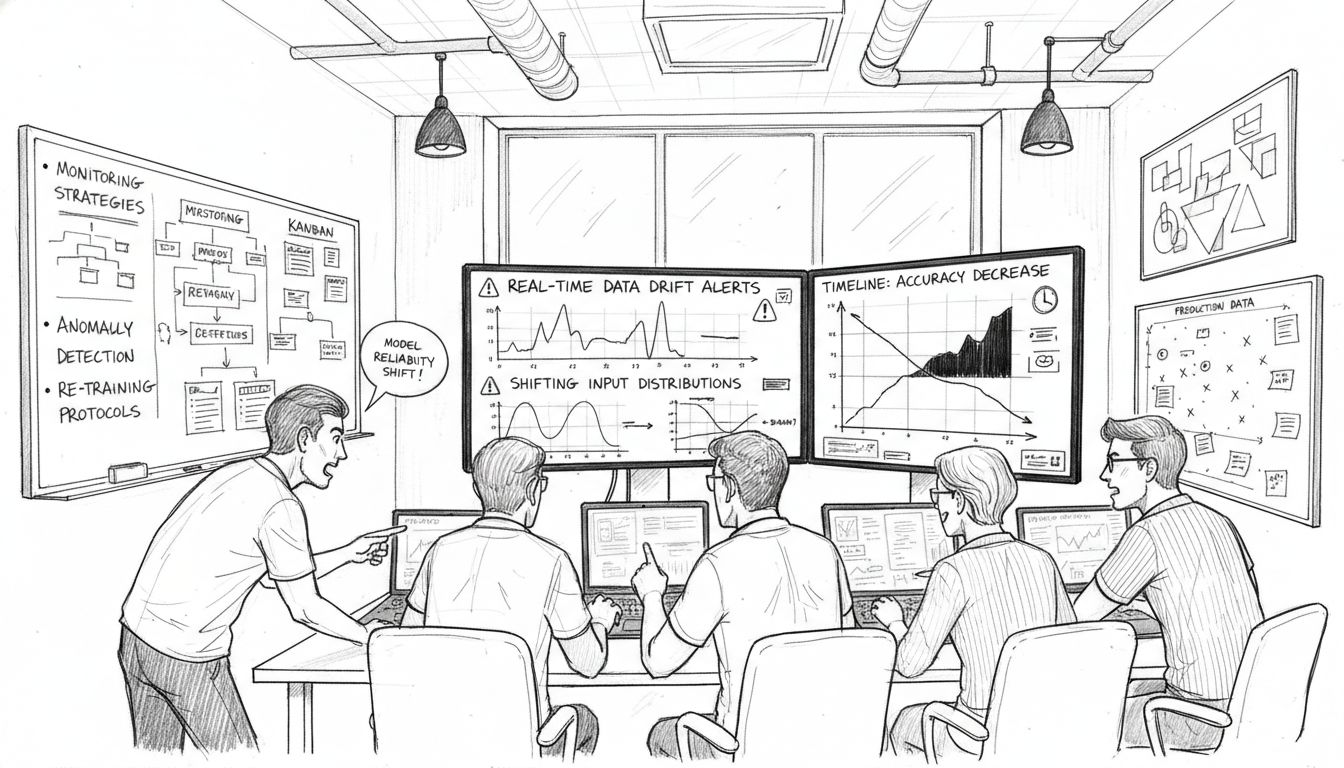
What Is Data Drift - Complete Guide for AI Engineers
Most machine learning models slowly lose accuracy as their input data changes in ways that developers never intended. Over 80 percent of AI teams identify unexpected data drift as a top reason for model failure. When the patterns in real-world data shift, even the best algorithms can start making costly mistakes. Understanding data drift, what triggers it, and how to spot it early can mean the difference between a high-performing model and one that silently erodes business value.
Table of Contents
- Defining Data Drift In Machine Learning
- Types Of Data Drift And Key Differences
- Causes And Common Triggers Of Data Drift
- Detecting And Measuring Data Drift Effectively
- Impacts On Model Performance And Operations
- Best Practices For Managing Data Drift
Defining Data Drift in Machine Learning
In the rapidly evolving landscape of artificial intelligence, data drift represents a critical challenge that can silently erode machine learning model performance. According to DataCamp, data drift occurs when the distribution of input data changes over time, potentially causing models to become less accurate as they were trained on different data distributions.
At its core, data drift describes the phenomenon where the statistical properties of a predictive model’s input data transform unexpectedly, undermining the model’s original learning and predictive capabilities. Wikipedia explains this as an evolution of data that invalidates a data model, specifically when the statistical properties of the target variable change over time, leading to decreased prediction accuracy.
To understand data drift, imagine training a machine learning model to predict customer behavior based on historical data. If customer preferences, economic conditions, or demographic patterns shift dramatically, the original model’s predictions will gradually become less reliable. This gradual deviation from expected performance is precisely what data drift represents. AI engineers must continuously monitor and adapt their models to maintain accuracy in dynamic environments.
Key characteristics of data drift include:
- Subtle changes in data distribution
- Gradual degradation of model performance
- Unpredictable variations in input features
- Potential misalignment between training and real-world data
Understanding how to detect and mitigate data drift is crucial for maintaining the effectiveness of machine learning systems across various domains. For a deeper exploration of detection techniques, check out my understanding data drift detection article.
Types of Data Drift and Key Differences
Understanding the nuanced landscape of data drift requires recognizing its distinct types and their unique impacts on machine learning models. DASCA categorizes data drift into three primary types: covariate shift, prior probability drift, and concept drift, each representing a different mechanism by which model performance can degrade.
Let’s break down these types in detail. Covariate shift occurs when the distribution of input features changes dramatically, effectively creating a mismatch between the training data and real-world data. Imagine training a loan approval model using historical financial data, but economic conditions shift, rendering the original feature distributions less representative. Prior probability drift involves transformations in the target variable’s distribution. This means the underlying patterns or outcomes you’re predicting start changing independently of input features.
Concept drift represents the most complex form of data drift, where the fundamental relationship between input features and output variables evolves over time. According to IJSRA, this type of drift significantly impacts machine learning models by altering how inputs translate into outputs. A classic example would be a recommendation system where user preferences and behavior patterns transform unpredictably.
Key differences between these drift types include:
- Covariate Shift: Changes in input feature distributions
- Prior Probability Drift: Modifications in target variable distribution
- Concept Drift: Fundamental changes in input-output relationships
For AI engineers, recognizing these distinctions is crucial for developing robust monitoring and mitigation strategies. To explore more advanced detection techniques, check out my model drift definition and solutions article.
Causes and Common Triggers of Data Drift
Understanding the root causes of data drift is crucial for AI engineers seeking to maintain model performance in dynamic environments. IJSRA highlights that data drift emerges from complex interactions between environmental changes, seasonal variations, and shifts in user behavior, creating significant discrepancies between training and real-world data distributions.
External environmental factors play a massive role in triggering data drift. Economic shifts, technological advancements, and global events can dramatically alter the underlying patterns that machine learning models depend on. For instance, the COVID-19 pandemic fundamentally transformed consumer behavior across multiple industries, rendering pre-pandemic predictive models substantially less accurate. Recommendation systems, fraud detection algorithms, and customer segmentation models all experienced significant performance degradation during this period.
SciSimple emphasizes that data drift is often initiated by nuanced changes in data collection methods and evolving user preferences. These subtle transformations can create imperceptible but persistent shifts in model performance. Consider a credit scoring model trained on historical financial data: changes in credit reporting practices, emerging financial technologies, or shifts in lending regulations could incrementally undermine the model’s predictive capabilities.
Key triggers of data drift include:
- Seasonal behavioral variations
- Technological ecosystem changes
- Economic policy transformations
- Shifts in demographic patterns
- Emerging user interaction paradigms
To gain deeper insights into managing these challenges, explore my understanding concept drift in AI models article and develop robust strategies for maintaining model reliability.
Detecting and Measuring Data Drift Effectively
Detecting data drift requires sophisticated techniques that go beyond simple statistical comparisons. arXiv introduces an innovative approach utilizing classifier confidence levels to identify distribution changes, offering a powerful method for detecting potential performance degradation without requiring labeled production data.
AI engineers have multiple strategies for measuring data drift, each with unique strengths. Statistical methods like population stability index (PSI), Kullback-Leibler divergence, and Jensen-Shannon divergence provide quantitative measurements of distribution shifts. Machine learning models can also be deployed as drift detectors, monitoring changes in prediction probabilities or model performance metrics as indirect indicators of underlying data transformations.
arXiv proposes an end-to-end framework for reliable, model-agnostic change-point detection that enables comprehensive drift interpretation across large-scale systems. This approach emphasizes not just detecting drift, but understanding its root causes and potential implications for model performance. By implementing sophisticated monitoring techniques, AI engineers can proactively identify and mitigate potential performance degradation before it significantly impacts system reliability.
Key techniques for detecting data drift include:
- Statistical distribution comparison
- Prediction probability tracking
- Performance metric monitoring
- Machine learning-based drift detection
- Automated feature importance analysis
To develop robust drift detection strategies that protect your AI systems, explore my understanding concept drift in AI models article and learn advanced monitoring approaches.
Impacts on Model Performance and Operations
arXiv highlights a critical challenge in machine learning: data drift leads to significant performance degradation and operational inefficiencies. Model performance erosion can occur gradually, making it challenging for AI engineers to pinpoint exactly when their predictive systems begin to lose reliability.
The cascading impacts of data drift extend far beyond simple prediction accuracy. Mission-critical systems like financial risk assessment, healthcare diagnostics, and fraud detection become increasingly unreliable as underlying data distributions transform. Imagine a credit scoring model that becomes 20% less accurate due to shifting economic conditions, potentially resulting in millions of dollars of misguided financial decisions. These performance declines aren’t just technical nuisances - they represent tangible business risks.
Operational challenges introduced by data drift require proactive, sophisticated monitoring strategies. AI systems must be designed with adaptive mechanisms that can dynamically detect and respond to distribution shifts. This means implementing continuous validation processes, developing robust retraining pipelines, and creating fallback mechanisms that can maintain system reliability even when primary models experience performance degradation.
Key operational impacts of data drift include:
- Reduced prediction accuracy
- Increased false positive/negative rates
- Higher computational retraining costs
- Compromised decision-making reliability
- Potential regulatory compliance risks
To develop comprehensive strategies for managing these challenges, explore my guide on evaluating model performance and learn advanced techniques for maintaining AI system integrity.
Best Practices for Managing Data Drift
IJSRA emphasizes the critical importance of implementing comprehensive MLOps strategies to effectively manage data drift in real-time systems. Modern AI engineering requires a proactive, multi-layered approach that goes beyond traditional model development, focusing on continuous monitoring and adaptive learning techniques.
Continuous performance tracking is the cornerstone of drift management. AI engineers must establish robust monitoring frameworks that capture subtle changes in data distribution, prediction accuracy, and model behavior. This involves setting up automated alert systems, implementing statistical divergence tests, and creating baseline performance metrics that trigger immediate investigation when significant deviations occur. Real-time monitoring allows teams to detect and respond to drift before it significantly impacts system reliability.
DASCA recommends employing adaptive learning techniques and regularly updating models with data reflecting current distributions. This approach requires developing flexible machine learning pipelines that can seamlessly integrate new training data, retrain models incrementally, and maintain performance accuracy across changing environments. Techniques like online learning, transfer learning, and ensemble methods become crucial in creating resilient AI systems that can dynamically adjust to evolving data landscapes.
Key best practices for managing data drift include:
- Implement continuous model performance monitoring
- Establish automated drift detection mechanisms
- Create flexible retraining and update protocols
- Develop robust data validation pipelines
- Use adaptive machine learning techniques
To gain deeper insights into maintaining high-quality AI systems, explore my guide on understanding data quality in AI and enhance your engineering capabilities.
Frequently Asked Questions
What is data drift in machine learning?
Data drift refers to the phenomenon where the statistical properties of input data change over time, causing machine learning models to become less accurate as they were trained on differing data distributions.
What are the types of data drift?
The three primary types of data drift are covariate shift, prior probability drift, and concept drift, each affecting model performance in different ways by altering input feature distributions, target variable distributions, and the relationship between inputs and outputs, respectively.
How can data drift impact model performance?
Data drift can lead to reduced prediction accuracy, increased false positive and negative rates, and compromised decision-making reliability, thereby creating significant operational inefficiencies and risks for mission-critical systems.
What are the best practices for managing data drift?
Best practices for managing data drift include implementing continuous model performance monitoring, establishing automated drift detection mechanisms, creating flexible retraining protocols, and utilizing adaptive machine learning techniques to ensure models remain up-to-date with changing data distributions.
Want to learn exactly how to implement robust drift detection systems for your production models? Join the AI Engineering community where I share detailed tutorials, code examples, and work directly with engineers building reliable ML monitoring systems.
Inside the community, you’ll find practical, results-driven data drift management strategies that actually work for growing companies, plus direct access to ask questions and get feedback on your implementations.
Recommended
- Understanding Data Drift Detection in Machine Learning
- Model Drift Explained Detecting, Types, and Solutions
- Understanding What is Concept Drift in AI Models
- Understanding Data Quality in AI Key Concepts Explained
- AI Advertising Strategies: Insights & Trends - Ads Daddy