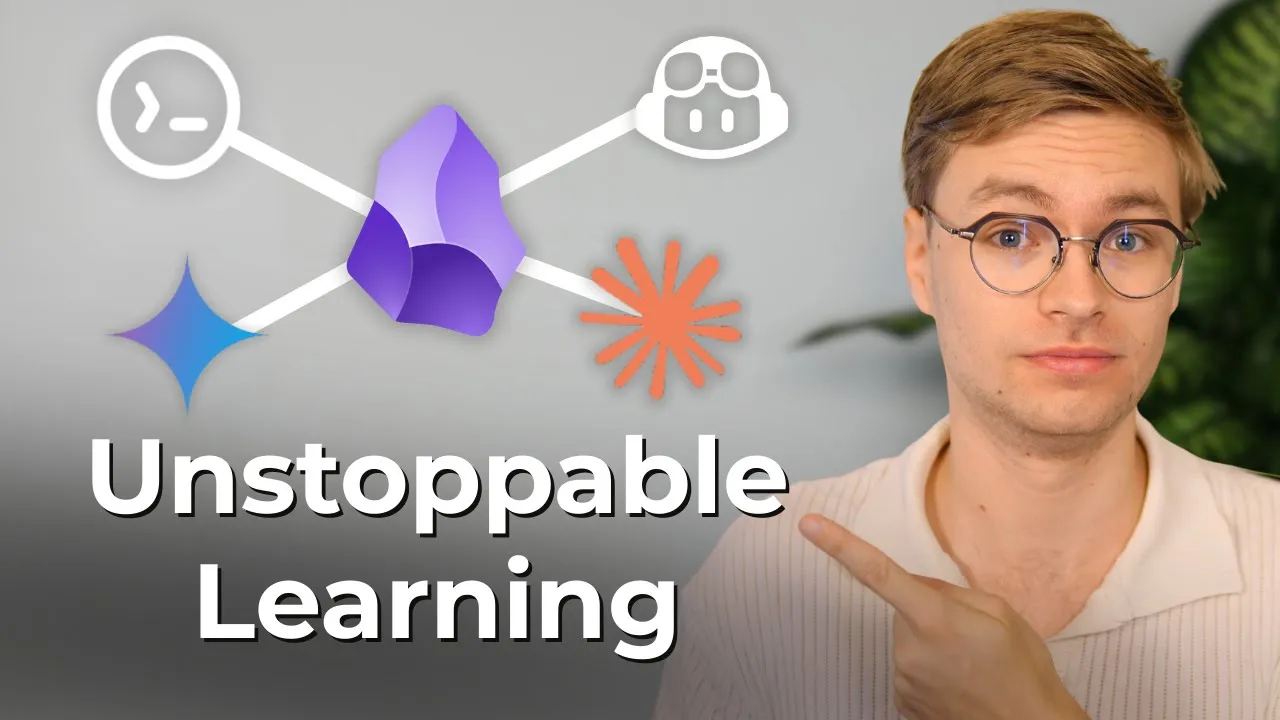
Why AI Engineers Need Knowledge Graph Systems
AI engineering moves at a ridiculous pace. Every week there’s a new framework to learn, a new architecture to understand, a new best practice to adopt. If you’re trying to keep all of that in your head, you’re going to struggle. And if you’re just taking random notes without any structure, you’re not much better off.
I realized this problem when I kept finding myself re-learning the same concepts because I couldn’t remember where I’d encountered them before. Or I’d start working on a new project idea only to realize I’d already explored something similar six months ago. That’s when I knew I needed a better system.
The Information Overload Problem
Here’s the reality. As an AI engineer, you’re constantly consuming information from multiple sources. You’re reading documentation for new libraries. You’re watching tutorials on YouTube. You’re building projects and learning from the problems you encounter. You’re participating in communities and picking up insights from other engineers.
All of that information is valuable. The problem is that without a system to organize it, most of it just disappears. You might remember the general idea, but you lose the specific details and connections that make knowledge actually useful.
Traditional note-taking doesn’t solve this problem either. Linear notes in a document or notebook don’t capture how different concepts relate to each other. When you’re learning about AI agents, that knowledge should connect to your understanding of API design, prompt engineering, and system architecture. But in a linear note-taking system, those connections are invisible.
That’s the fundamental problem knowledge graphs solve. Instead of isolated notes, you get an interconnected web of concepts where relationships are explicit and searchable.
How Interconnected Knowledge Beats Linear Notes
Think about how your brain actually works. You don’t store information in neat, separate categories. When you think about one concept, it triggers associations with related ideas. Knowledge graphs mirror this natural structure.
In my knowledge graph, every concept exists as a node that connects to other related nodes. When I look at something like AI coding systems, I can immediately see all the specific technologies that fall under that umbrella. I can see the broader concepts it relates to. I can trace connections from one idea to another and discover relationships I hadn’t consciously recognized.
This interconnected structure makes learning faster because you’re not just memorizing isolated facts. You’re building a web of understanding where new information automatically connects to what you already know. When you learn a new AI framework, it slots into your existing knowledge graph and links to related concepts, architectures, and use cases you’ve already encountered.
Using Your Knowledge Graph to Identify Learning Gaps
One of the most valuable things about having a visual knowledge graph is seeing what you don’t know yet. When all your knowledge is mapped out, the gaps become obvious.
Maybe you realize you have a lot of knowledge about different AI models but very little about deployment and infrastructure. Or you might notice that you understand the theory of AI agents really well but haven’t explored many practical implementation patterns. These insights are incredibly valuable for planning your learning journey strategically.
Instead of randomly jumping between topics or following whatever tutorial happens to catch your attention, you can identify the specific areas where deepening your knowledge would be most valuable. You can see where you have surface-level understanding and where you’ve actually gone deep.
Discovering Connections Between Concepts and Technologies
The real magic happens when you start discovering unexpected connections. You might realize that three different projects you worked on all used similar approaches to a particular problem. Or you might notice that certain technologies consistently appear together in your work.
These patterns aren’t obvious when you’re just working through projects one at a time. But when you can see everything mapped out in a knowledge graph, the connections jump out at you. And those connections often lead to insights that make you a better engineer.
For example, you might discover that the way you approach API design for AI systems shares principles with how you structure prompts for language models. That realization might change how you think about both topics. Or you might notice that certain AI development tools work particularly well together, which influences your technology choices for future projects.
Practical Benefits for Your Career
Let’s talk about concrete benefits. First, faster learning. When new information connects to existing knowledge, it sticks better. Your knowledge graph makes those connections explicit, which means you retain more and understand concepts more deeply.
Second, better decision making. When you’re choosing technologies for a new project, you can review your knowledge graph and see what you’ve used before, what worked well, and what problems you encountered. You’re making decisions based on your actual experience, not just vague recollections.
Third, avoiding repetition. This is huge if you create any kind of content, whether that’s blog posts, tutorials, or presentations. Your knowledge graph shows you exactly what ground you’ve already covered and what angles you haven’t explored yet. You’re not accidentally repeating yourself or forgetting about valuable insights from past work.
Fourth, generating better ideas. When you can see connections between different concepts, you naturally come up with more creative and interesting ideas. You might combine approaches from two different areas to solve a problem in a novel way. Or you might identify opportunities to apply lessons from one domain to challenges in another.
Why This Matters Now More Than Ever
The AI field is only going to move faster. More tools, more frameworks, more techniques, more best practices. If you don’t have a system for organizing and connecting all of this knowledge, you’ll constantly feel behind and overwhelmed.
A knowledge graph gives you a way to keep up without burning out. Instead of trying to hold everything in your head, you externalize your knowledge into a searchable, visual system. Instead of linear notes that get buried and forgotten, you build an interconnected web that grows more valuable over time.
This isn’t just about productivity or efficiency. It’s about developing genuine expertise in a field that rewards deep understanding and creative problem-solving. When you can see the big picture of everything you’ve learned and how it all connects, you develop the kind of insight that separates good engineers from great ones.
To see exactly how I built my knowledge graph system and how it helps me track concepts, generate ideas, and accelerate my learning, watch the full video tutorial on YouTube. I show you the complete system in action and explain how you can create something similar for yourself. If you’re serious about growing your AI engineering skills and want to connect with others on the same path, join the AI Engineering community where we share knowledge, insights, and support each other’s growth.